Sunita “Suni” Williams, one of the most accomplished Indian American astronauts in history, has officially retired from the National Aeronautics and Space Administration after a distinguished 27-year career marked by trailblazing achievements in human spaceflight. NASA announced Williams’s retirement on January 20, 2026, noting that she stepped away from the agency effective December 27, 2025, closing a remarkable chapter that included multiple historic missions, record-setting spacewalks, and enduring contributions to America’s space exploration efforts.
Williams’s career with NASA began in 1998 when she was selected as an astronaut candidate. Over the next nearly three decades, she became synonymous with persistence, leadership, and scientific rigor aboard orbiting space stations and in the vacuum of space itself. At the time of her retirement, she was among the most experienced astronauts in NASA’s history, having logged a cumulative 608 days in space across three missions – a total second only to a handful of her peers and exceptionally notable among U.S. spacefarers.
Her early spaceflight experiences cemented her reputation for excellence and stamina. Williams first flew in space in 2006 aboard Space Shuttle Discovery on STS-116, serving as a flight engineer and performing multiple spacewalks. She returned to orbit in 2012, launching aboard a Russian Soyuz spacecraft for Expeditions 32 and 33 at the International Space Station, where she also served as commander – a leadership role that reflected NASA’s confidence in her operational command and technical judgment.
Perhaps the most widely publicized chapter of Williams’s career came during her final mission, which launched in June 2024 aboard Boeing’s Starliner spacecraft – the first crewed flight for the company’s new crew capsule. What was planned to be a brief test flight evolved into an extraordinary long-duration stay when technical issues with the Starliner prevented an immediate return. Williams, alongside fellow astronaut Butch Wilmore, adapted to the evolving mission and remained aboard the ISS for an extended period, ultimately returning in March 2025 aboard a SpaceX Crew-9 Dragon capsule.
This unplanned odyssey underscored both the inherent complexities of human space exploration and Williams’s capacity for resilience and professionalism under unprecedented conditions. The nine-month service aboard the ISS not only contributed to station operations but also offered invaluable insights into long-duration space habitation – knowledge that will inform future missions to the Moon and Mars under NASA’s Artemis program.
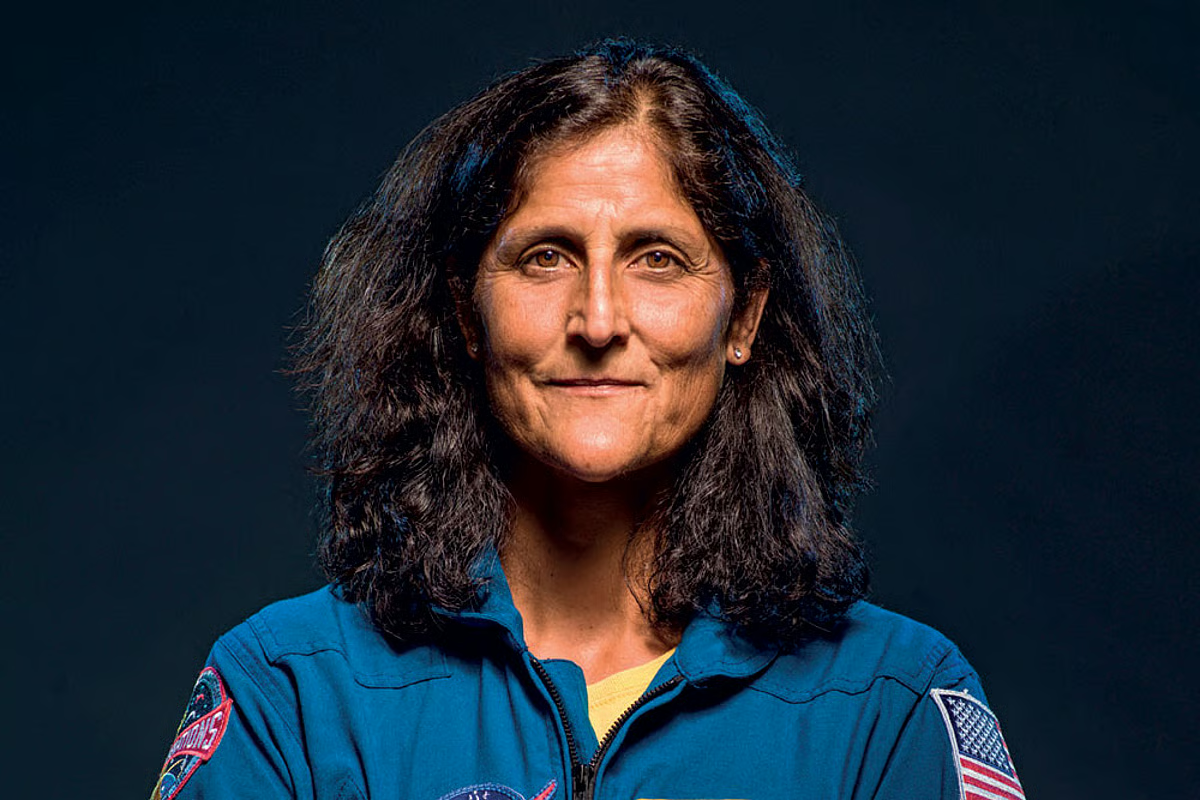
Throughout her career, Williams set multiple benchmarks that resonated across the space community and beyond. With nine spacewalks totaling over 62 hours and six minutes, she holds the record for the most cumulative spacewalking time by a woman and stands among the all-time leaders in career extravehicular activity. She also achieved a singular milestone by becoming the first person to run a marathon in space, completing the distance on a treadmill aboard the ISS, a feat that captured public imagination and reflected the interplay between human endurance and scientific curiosity.
Her technical expertise was matched by her operational versatility. Beyond her spaceflights, Williams participated in NASA’s extreme environment missions, served in leadership roles such as deputy chief of the Astronaut Office, and worked to prepare future crews for missions beyond low Earth orbit. In NASA’s official retirement announcement, Administrator Jared Isaacman lauded Williams as “a trailblazer in human spaceflight” whose leadership aboard the space station and engagement in commercial crew missions helped pave the way for the next generation of explorers.
Williams’s heritage as an Indian American -born in Ohio to a father of Gujarati descent – has also contributed to her visibility as a role model for aspiring scientists and explorers from diverse backgrounds. Her achievements have been celebrated by diaspora communities in the United States and internationally, reinforcing the narrative of inclusive leadership in science and technology.
As NASA transitions toward future expeditions, including the Moon-bound Artemis missions and eventual crewed voyages to Mars, the legacy of astronauts like Williams will remain integral to institutional memory and ambition. Her career reflects the sustained commitment of American spaceflight to expand human presence beyond Earth while integrating scientific inquiry, international collaboration, and personal courage.
Williams’s departure from active service comes at a moment of generational change in NASA’s astronaut corps, yet her impact will persist in the training of new explorers, the engineering of spacecraft, and the larger cultural imagination around human space travel. Her retirement marks both a culmination of distinguished service and an invitation for new leaders to take up the challenge of exploration that she helped define.
Key Takeaways About Sunita Williams
- Indian American astronaut Sunita Williams retired from NASA effective December 27, 2025 after a 27-year career.
- She logged 608 cumulative days in space over three missions – one of the highest totals among U.S. astronauts.
- Williams holds the record for the most spacewalking time by a woman, with over 62 hours across nine spacewalks.
- Her final mission involved an extended stay aboard the ISS due to spacecraft technical issues, showcasing resilience and adaptability.
- NASA praised her contributions as foundational to future Artemis missions and deeper space exploration.