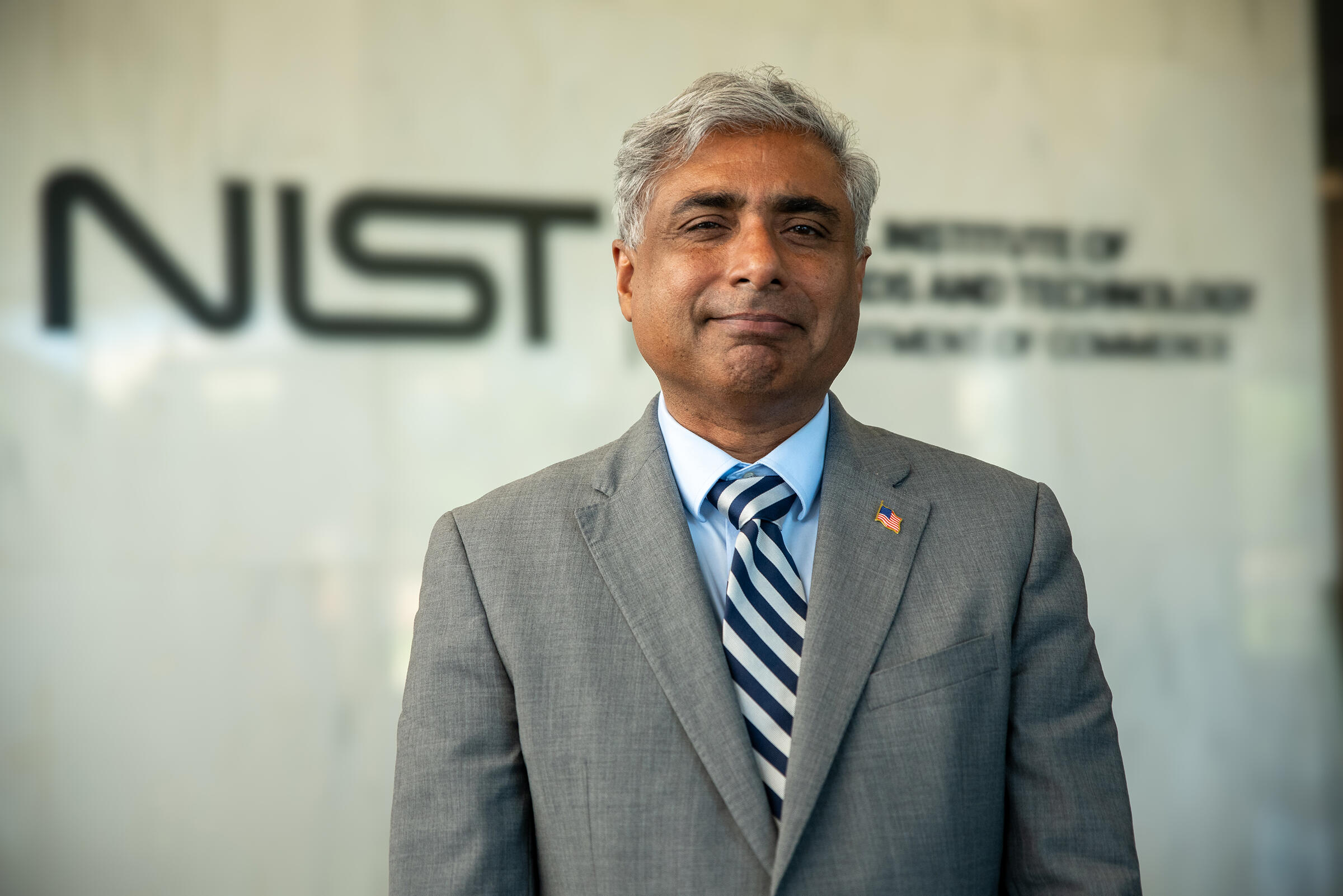
Arvind Raman has been sworn in as the 18th director of the National Institute of Standards and Technology, taking leadership of the federal agency responsible for advancing measurement science, standards and technological innovation.
Raman was sworn in on June 30, 2026, by U.S. Secretary of Commerce Howard Lutnick. He also serves as under secretary of commerce for standards and technology. NIST published its formal announcement confirming his new role in July.
His appointment places an Indian-born engineer and academic administrator at the head of an institution whose work affects advanced manufacturing, cybersecurity, artificial intelligence, quantum science, biotechnology and other strategically important fields.
NIST develops technical measurements and standards that help industries evaluate products, ensure interoperability and improve safety and reliability. Although much of its work occurs outside public view, the agency plays a foundational role in the U.S. innovation economy.
Raman joins NIST after a long career at Purdue University, where he served as dean of the College of Engineering and professor of mechanical engineering. His research has included nonlinear dynamics, nanotechnology, biomechanics and atomic force microscopy.
He earned a bachelor’s degree in mechanical engineering from the Indian Institute of Technology Delhi, a master’s degree from Purdue University and a doctorate from the University of California, Berkeley. Official and academic biographies identify Raman as India-born and describe his move to the United States for graduate education.
At Purdue, Raman oversaw one of the country’s largest engineering colleges. His leadership included responsibility for research, academic programs, faculty recruitment and partnerships involving government and industry.
That background is particularly relevant as NIST confronts questions that extend beyond laboratory research. The agency is increasingly involved in national discussions about artificial intelligence evaluation, cybersecurity frameworks, semiconductor manufacturing and standards for emerging technologies.
Technical standards can influence which products reach the market, how businesses compete and whether systems developed by different companies can work together. They also help policymakers translate broad technology priorities into measurable and enforceable practices.
Raman’s appointment is therefore significant beyond the scientific community. He will lead NIST during a period when the United States is seeking to strengthen domestic manufacturing, protect critical infrastructure and remain competitive in technology-intensive industries.
The role is also an important milestone for South Asian American representation in federal science and technology leadership. Indian American scientists and engineers have long contributed to U.S. universities, national laboratories and technology companies. Raman’s appointment places that experience at the head of a major federal research and standards agency.
His tenure will be closely watched as NIST balances scientific independence, industrial collaboration and federal policy priorities. The agency’s work under Raman could shape how emerging technologies are measured, standardized and adopted across the United States.
Key Takeaways About Arvind Raman
- Arvind Raman was sworn in as the 18th director of NIST on June 30, 2026.
- He also serves as under secretary of commerce for standards and technology.
- Raman previously served as dean of Purdue University’s College of Engineering.
- He earned his undergraduate engineering degree from the Indian Institute of Technology Delhi.
- NIST plays a central role in U.S. standards, cybersecurity, advanced manufacturing and emerging technology.