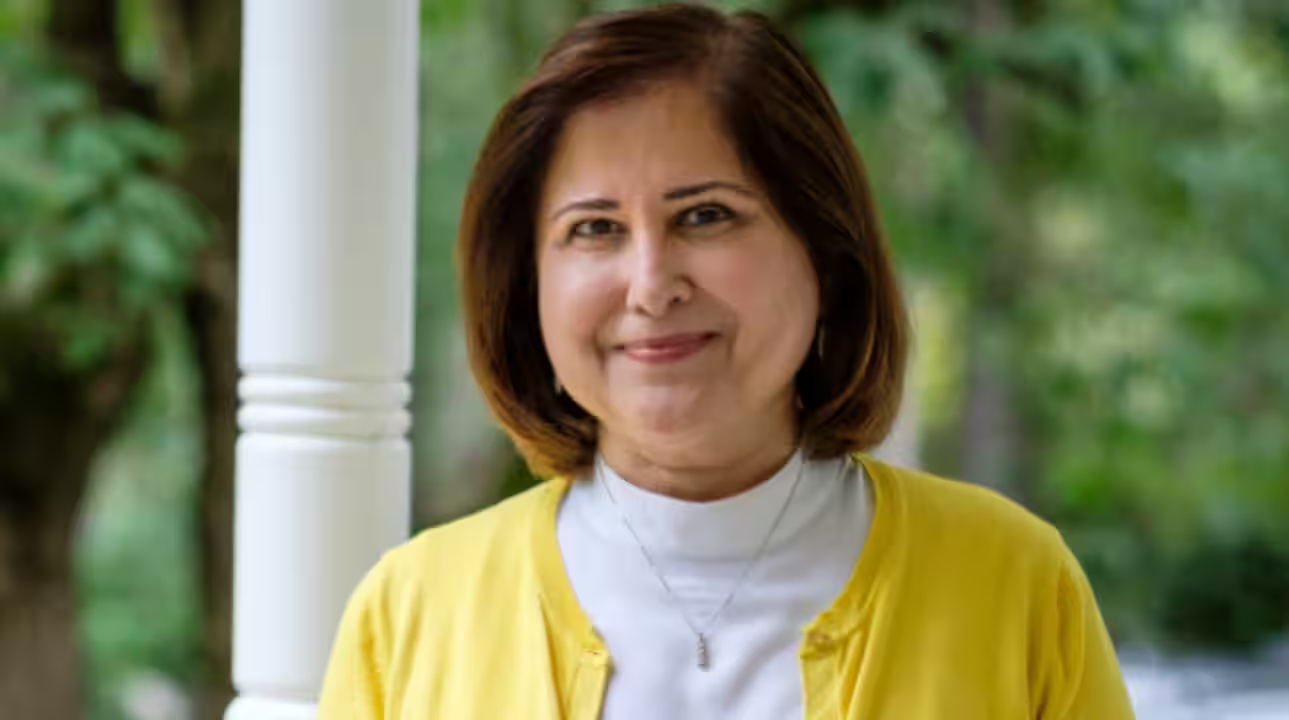
Virginia made history this week as voters elected Ghazala Firdous Hashmi to serve as the state’s next lieutenant governor, marking a watershed moment for representation in American politics. With this victory, Hashmi becomes the first Muslim woman and the first South Asian American to win statewide office in Virginia’s 246-year history.
Hashmi, 61, a Democrat and longtime educator, defeated Republican challenger Winsome Sears in the November 4, 2025 general election. Her election follows a distinguished career spanning academia, community engagement, and public service, and underscores Virginia’s evolving demographic and political identity.
Born in Hyderabad, India, Hashmi immigrated to the United States as a child and earned her Ph.D. in English from Emory University. Before entering politics, she spent more than two decades in higher education, serving as a professor and later as founding director of the Center for Excellence in Teaching and Learning at Reynolds Community College.
Her 2019 election to the Virginia Senate had already made history – she was the first Muslim woman to serve in that chamber. Over two terms, Hashmi became known for her advocacy on education, voting rights, and healthcare access. As a senator, she sponsored legislation to expand early childhood education, reduce prescription drug costs, and improve mental health resources across the Commonwealth.
Now, as lieutenant governor, Hashmi will preside over the state Senate and play a key role in advancing the new Democratic administration’s legislative agenda. She has emphasized priorities such as strengthening public schools, safeguarding reproductive rights, and accelerating Virginia’s clean-energy transition.
In her victory address in Richmond, Hashmi reflected on her journey from immigrant student to statewide leader: “When I first arrived in this country as a young girl, I could never have imagined standing here today. But this moment is not about me-it’s about the millions of Virginians who believe in a more inclusive, compassionate, and forward-looking Commonwealth.”
Hashmi’s win comes amid a broader surge of South Asian American political engagement across the U.S. This election cycle saw record turnout among Asian American voters in Virginia, signaling growing civic participation and representation in the South. Analysts note that Hashmi’s victory could influence Democratic strategies across other Southern states, where diverse suburban electorates are increasingly decisive.
Her background in education also brings a crucial perspective to state leadership. Having spent much of her career in community colleges, Hashmi understands firsthand the challenges students and educators face. Supporters believe her academic grounding will help shape evidence-based policy in workforce development and public education-key sectors driving Virginia’s economy.
Civic leaders and advocacy groups praised the symbolism of her victory. The Council on American-Islamic Relations called it “a milestone that reaffirms America’s promise of opportunity and pluralism.” South Asian community organizations across Virginia and neighboring states echoed that sentiment, emphasizing that representation at the top levels of government can help combat bias and foster belonging.
Beyond identity, however, Hashmi’s rise reflects years of grassroots dedication. Constituents often describe her as approachable, thoughtful, and policy-driven-a combination that resonates across partisan lines. In the Senate, she earned respect for her collaborative approach and her ability to navigate complex committees with empathy and intellect.
Nationally, Hashmi’s ascent strengthens the growing cohort of South Asian American women in public leadership, including Vice President Kamala Harris, Representative Pramila Jayapal, and Mayor Sumbul Siddiqui of Cambridge. Together, they represent a new generation of leaders bridging immigrant experiences with American governance.
Hashmi’s success story also carries personal meaning for countless immigrants and women of color balancing family, career, and public service. As she often notes, “We are not newcomers to the American story-we are authors of its next chapter.”
As lieutenant governor, Hashmi is expected to advance education and social equity initiatives, while working closely with Governor-elect Abigail Spanberger on bipartisan economic measures. Early statements from her office indicate plans to establish a “Community College Compact,” linking education funding to workforce readiness, and to promote broadband expansion across rural Virginia.
The symbolism of her swearing-in next January will be hard to miss: a woman of Indian descent, raised in the American South, presiding over a chamber once emblematic of segregation-era politics. For many Virginians, that image alone captures how far the state has come.
Key Takeaways About Ghazala Firdous Hashmi
- First Muslim woman and first South Asian American elected statewide in Virginia.
- Immigrant from Hyderabad, India; former professor and academic leader.
- Longtime advocate for education, healthcare access, and reproductive rights.
- Her election reflects growing Asian American political influence in the South.
- Brings decades of experience in higher education and public policy to her new statewide role.