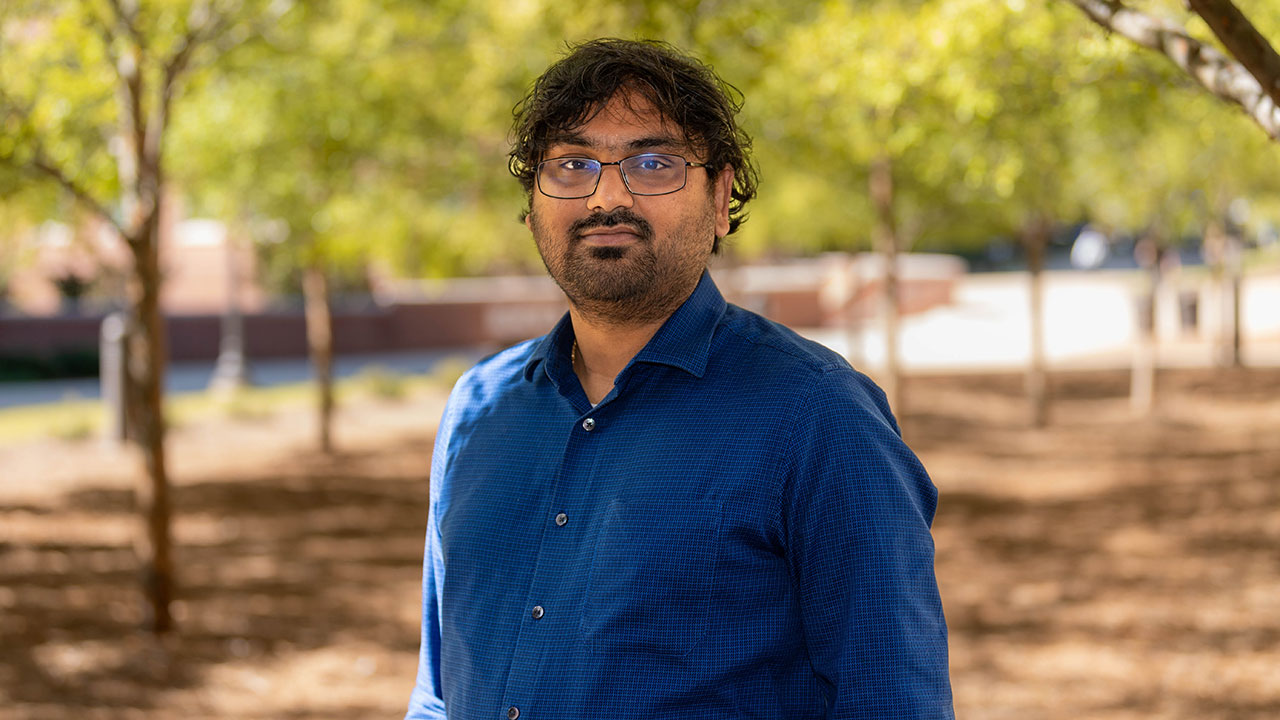
Auburn University computer scientist Sathya Aakur has received a $561,000 National Science Foundation award to develop artificial intelligence methods that help robots understand how objects can be used, not simply identify what they are.
Aakur is an associate professor in Auburn’s Department of Computer Science and Software Engineering and directs the Open-ended Reasoning and Knowledge Acquisition Laboratory. His project, “Principle-Driven Embodied Vision: Autonomous Radiance Manifold Exploration for Functional Affordance Discovery,” addresses a major challenge in robotic perception.
Current vision systems can recognize an object such as a spoon, knife or container. Aakur’s research asks whether robots can also reason about an object’s functional properties and adapt when the expected tool is unavailable. A robot seeking to scoop something, for example, would need to determine whether another object could perform the same function.
The project will allow embodied AI systems to recognize gaps in their understanding, reposition themselves and collect additional visual information before acting. Instead of relying on a single viewpoint, the robots will create persistent three-dimensional scene models that integrate observations from several positions.
Researchers will evaluate the technology through retrieval and manipulation tasks. The systems must identify which object, or which part of an object, is best suited to complete a requested function. The work could improve the flexibility of robotic systems operating in homes, workplaces and unfamiliar environments.
Aakur’s laboratory is testing the methods on several physical platforms. They include a desktop robotic arm, a quadruped robot equipped with an arm and a wheeled LocoBot that uses lidar for navigation. He also hopes to test the technology on a humanoid robot.
The Indian-origin researcher earned his undergraduate degree in electronics and communication engineering from Anna University in India. He later completed graduate degrees in management information systems and computer science and engineering at the University of South Florida.
Aakur was named a Ginn Faculty Achievement Fellow in 2025. The NSF award advances his broader work in computer vision and open-ended machine reasoning while helping robots respond more intelligently when real-world conditions differ from their training.
Key Takeaways About Sathya Aakur
- He received a $561,000 National Science Foundation award.
- His research will help robots reason about how objects can be used.
- He directs Auburn’s Open-ended Reasoning and Knowledge Acquisition Laboratory.
- His laboratory is testing the technology on several robotic platforms.
- He earned his undergraduate engineering degree from Anna University.