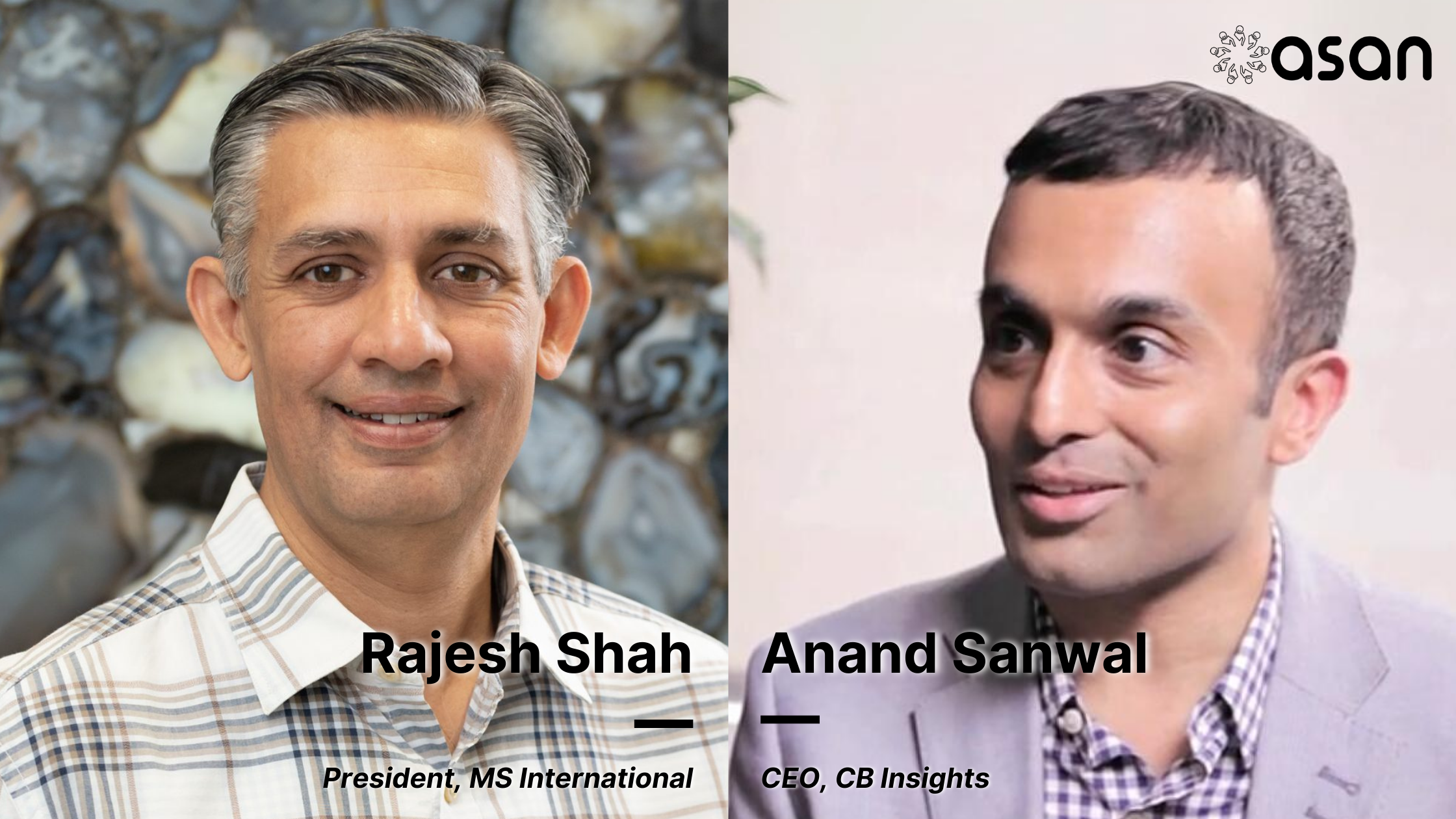
On September 9, 35 students will walk into Forge Prep in Livingston, New Jersey, becoming the first class in a new school founded by South Asian entrepreneurs Raj Shah and Anand Sanwal.
Shah, Co-CEO of MS International (MSI), and Sanwal, founder of CB Insights, have spent their careers building companies, questioning assumptions and adapting faster than the markets around them.
Now they are applying that same operating mindset to education.
Forge Prep is designed around a simple premise: students should leave school able to do more than perform well on tests. They should know how to think independently, solve real problems, communicate, build, adapt and take ownership.
The school starts with grades 5 through 8 and plans to expand through grade 12. Students will build real businesses, conduct original research, design products, work with mentors and receive individualized coaching.
For Sanwal, getting there started with his own kids.

Anand Sanwal Went Back to School
Sanwal’s daughter would repeatedly ask him a question familiar to almost every parent:
When will I ever use this?
His son struggled with sitting still through work he found boring.
Sanwal eventually realized that his answers amounted to some version of: I had to do it, so you do too.
That bothered him.
He started talking to other parents and heard the same stories: children questioning the relevance of what they were learning, losing interest and being told to keep going because that was simply how school worked.
Sanwal began wondering whether the problem was less about the kids and more about the system built around them.
After more than a decade building CB Insights, he immersed himself in education.
He went back to school to become a Montessori teacher focused on adolescents, studied education research and philosophy, and spoke with hundreds of families, students, teachers and school administrators.
He did not just decide education needed fixing.
He learned the work.
Sanwal’s profile calmly and confidently says it all: “Unf^cking Education.”
“If I was going to build a school, I needed to understand how kids actually learn,” Sanwal said. “So I went back to school.”
What he found was more encouraging than he expected.
The problem, in his view, was not that nobody knew how to improve education.
Much of it was already known.
“Education doesn’t need another breakthrough,” Sanwal said. “We already know a lot about what works. The opportunity is to actually build a school around it.”
Forge Prep is that attempt.
The $1,000 Fellowship Became the Proof
Before there was a school, Shah and Sanwal started testing one of its central ideas.
In 2025, they launched what is now the Forge Fellowship, giving $1,000 grants to middle and high school entrepreneurs across the country. The program continues today.
The Fellowship became an important stepping stone to Forge Prep because it gave the founders something beyond research or theory.
It gave them evidence.
They began meeting young people doing things adults rarely expect from middle and high school students.
Lincoln built a $60,000 Christmas-light installation business, finding customers, running online advertising and hiring and managing people.
Claire, at 14, taught herself to program NFC keychains, developed relationships with local retailers and generated thousands of dollars in revenue.
Ayaan navigated government licensing requirements as a ninth grader and built a $30,000 cookie business.
“Kids are capable of much more than we give them credit for,” Sanwal said. “Give them something that matters, real responsibility and the freedom to figure it out, and they learn incredibly fast.”
That became one of Forge Prep’s foundational ideas.
When work is relevant and students have genuine agency, learning stops being something imposed on them and becomes something they seek out because they need it.
The Fellowship continues to put $1,000 behind young builders across the country.
Forge Prep takes the same underlying belief and builds an entire school around it.
Raj Shah Knows What Learning by Doing Can Build
Shah brings a different but complementary perspective.
His parents, Manu and Rika Shah, started MSI from their home in 1975.
By 2003, the company was approaching $50 million in annual revenue. That year, Raj and his brother Rup left careers in investment banking and joined the family business.
The growth since has been extraordinary.
Raj and Rup became Co-Presidents as MSI approached $500 million in revenue, later crossed $1 billion and have since helped grow the company to roughly $3 billion in annual revenue.
Today, MSI is the largest wholesale distributor of flooring, countertops, wall tile and hardscaping products in North America.
That experience shapes how Shah thinks about education.
“A lot of what made us successful, we learned by doing,” Shah said. “You make decisions, you make mistakes, you adjust and you keep going. Kids should start building those muscles much earlier.”
MSI’s story is also a distinctly South Asian American one: immigrant parents build something from the ground up, the next generation joins it, and then expands what is possible.
Forge brings some of those same lessons into education much earlier.
“Our parents’ generation created opportunities by taking risks and figuring things out,” Shah said. “We want young people to develop that same confidence and resourcefulness before they enter the workforce.”
Expanding the South Asian Definition of Education
South Asian families have long treated education as a pathway to mobility, security and opportunity.
Shah and Sanwal are building on that tradition while broadening what a successful education should produce.
Academic achievement matters.
So do initiative, judgment, creativity, resilience, communication and the ability to operate when there is no answer key.
Forge’s model reflects that philosophy.
Students spend mornings on focused academic work and afternoons creating and building. Every student has a dedicated Guide responsible for their development, and students work with professionals and mentors beyond the school.
The school emphasizes four qualities: originality, adaptability, ownership and resilience.
The objective is larger than creating entrepreneurs.
It is about developing people who can walk into unfamiliar situations, understand problems, contribute and eventually lead.
A School Built Around Agency
Forge Prep approaches school differently because its founders started with a different question.
Instead of asking how to improve the existing model, they asked what qualities graduates should actually possess.
Instead of designing the day around institutional convenience, they looked at how young people develop.
Instead of asking how students can perform better on standardized tests, they asked what kind of education can withstand changes brought by technology and AI.
That produces some practical differences.
Students work on real products and problems.
They connect academic concepts to things they are actually building.
They receive one-on-one coaching.
They interact with mentors and professionals.
They develop portfolios showing what they have created and mastered through what Forge calls a Proof Transcript.
And the school is deliberately designed to give students more responsibility, not less.
“The goal is not to predict exactly what jobs will exist 15 years from now,” Shah said. “It is to build young people who can handle whatever comes next.”
Thirty-Five Students. September 9.
For all the research, philosophy and experimentation behind Forge Prep, the real test begins September 9.
Thirty-five students will walk through its doors.
The Fellowship showed Shah and Sanwal what could happen when young people were given capital, encouragement, responsibility and room to build.
Now they are taking that idea much further.
A bet that young people are chronically underestimated.
A bet that relevant work creates better learners.
A bet that academic rigor and real-world agency belong in the same school.
And a bet, led by two South Asian American entrepreneurs, that one of the most consequential things their generation can build is a better way to prepare the next one.